

Canterbury Christ Church University (CCCU)
We currently have a successful internship project involving collecting soil samples to carry out eDNA sequencing, looking specifically at soil fungi and bacteria.

We measure change in species, habitats and ecological processes to monitor progress towards a Wilder Blean.
In order to demonstrate the incredible potential of wilding as a nature-based solution to the climate and nature crises, it is crucial that we monitor the effects of our management actions across our reserves. This is particularly important at Wilder Blean where we are testing a novel management technique using European bison. Our results help to build an evidence base for our own adaptive management but also to support other projects across the UK.
Each year from 2021 to 2024, we looked at how the types and structure of plants changed across different treatments. We found different plant communities in each treatment. Some species, like birch and bracken, are most common in the bison and proxy areas, while sweet chestnut is dominant in the control area. There is evidence that seedlings are becoming more common in the bison and proxy areas, possibly because large herbivores are letting in more light by thinning adult trees. Bare ground and grasses decreased from 2021 to 2024, likely due to less machinery use and increased grazing by livestock and bison. The rangers observed strong initial impacts from grazing on grasses. In future surveys and reports, our understanding of grazer behaviour will deepen through field observations, GPS collar data, and further analyses.
Fifteen Sea, Land and Air Malaise (SLAM) traps were deployed and serviced for five months (May-September) in each year of 2021-2024 at a height of two meters, suspended in trees out of reach of livestock. On average, the control areas (with no grazing) had the highest number of invertebrates, followed by areas grazed by conservation livestock, and the lowest numbers were found in areas with bison, but this was due to its position in a confider plantation. The most invertebrates were found in areas of natural regeneration, where trees are growing back on their own. These were followed by open habitats, with the fewest invertebrates found in high forest areas. From 2026, in collaboration with the University of Kent, we will be leveling-up our invertebrate monitoring efforts, with a larger number of traps in a grid across the entire Wilder Blean site.
Butterfly abundance and diversity were monitored using standardized UK Butterfly Monitoring Scheme (UKBMS) transects between 2021 and 2024. We looked at whether butterfly numbers and diversity changed with different treatments, over time, and after bison were introduced. We found that butterfly numbers were highest in the areas grazed by cattle, ponies, and pigs, where there were more than four times as many butterflies as in the control area. Bison areas did not yet show higher overall numbers, but butterflies there increased more quickly through the season, which could mean bison will bring benefits over the longer term.
To understand how two important plants for the Heath Fritillary butterfly, Ribwort Plantain and Common Cow-wheat, were doing, we surveyed 673 square plots, each 100 by 100 meters, across the entire project area. We found that in 2022, there was less Ribwort Plantain, but in 2023, there was more. By 2024, the amount hadn't significantly changed from 2021 levels. So, we saw some ups and downs, but no big overall change in the plant's population over the three years. We also checked the amount of Common Cow-wheat growing each year from 2021 to 2024. Good news! We found no significant changes in how much Common Cow-wheat was present throughout this period. Its population remained stable. Continued long-term monitoring of both food plant and Heath Fritillary populations will be critical for adaptive management.
Reptile populations were surveyed by checking reptile refugia between 2021 and 2024. We found site-wide decreases in reptile populations, likely due to the extreme weather we've experienced in recent years. However, this decline wasn't observed in the area where Iron Age pigs had been present, suggesting their rootling and disturbance behavior could increase climate resilience of the ecosystem.
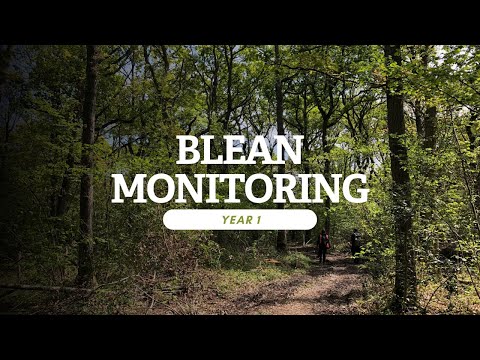
Our fantastic monitoring and evidence team and site wardens and volunteers are out on site all the time conducting extensive fieldwork and analysing data on almost everything on site, including soil health, insect and animal abundance, vegetation structure and natural processes.
Read on to find out how we are integrating technology, data and innovation to monitor our projects and contribute to the global dialogue on conservation.
Unmanned aerial vehicles, or drones, offer fantastic opportunities for monitoring habitat characteristics. We need to closely monitor the Blean environment to track the benefits to biodiversity that introducing European bison will have and contribute to the global scientific understanding of wilding.
By surveying the different experimental areas with the drone, we can collect a wealth of information about how the different management approaches influence the structure and composition of the woodland vegetation at the Blean.
Using a drone and two specific sensors, we can measure a range of habitat attributes:
The Wilder Blean project is designed as an experiment involving three areas across West Blean and Thornden Woods.
We’re following the BACI – ‘before, after, control, impact’ - study design. This means that not only will we be able to monitor the impact of reinstating a naturalistic grazing regime over time; watching, monitoring and measuring change, but we will also be able to compare the impacts of bison, in particular, with the impacts of longhorn cattle, whilst simultaneously watching and measuring how completely un-grazed areas within the site change and develop.
Area 1 is where we are introducing European bison, Exmoor ponies and Iron-Age pigs. The way bison graze and interact with their surroundings is unique as they target bark rather than other parts of a plant.
In Area 2 we will be introducing Longhorn cattle, a similarly large herbivore which doesn’t have the bison’s unique ecology and behaviour, Exmoor ponies and Iron-age Pigs.
The final Area 3 is a control area where no introduced grazing animals will be present and will be un-grazed and managed using traditional woodland management techniques.
This arrangement means that we will be able to monitor the impact of restoring a naturalistic grazing regime over time and we will also be able to compare the impacts of bison with the impacts of longhorn cattle.
© Adventure Alliance
In the UK, we’re headed for increasing species extinctions in the next 10 years, which is why ancient woodlands like the Blean are so important for our wildlife. We must act now to ensure a future for many of our treasured species.
Amazingly, monitoring at Blean has shown some incredible results already, which should only be enhanced by our wilding project.
Read more findings below:


Walckenaeria mitrata
We currently have a successful internship project involving collecting soil samples to carry out eDNA sequencing, looking specifically at soil fungi and bacteria.

The NHM are conducting comprehensive research to reveal insights into the effects of bison on soil health and carbon sequestration.

We are collaborating with the University of Huddersfield to investigate aquatic diversity from the ponds across Wilder Blean. They are examining invertebrate communities, water quality and other environmental conditions.

Royal Holloway University are looking at dung analysis as well as ground/dung beetles assemblages and pollen using pitfall traps.

We have partnered with the Durrell Institute of Conservation and Ecology on E3 Sharing Space for Nature, a five-year research initiative funded by Research England, focused on enhancing the role of conservation areas in tackling current environmental crises.

We are working with remote sensing experts, using LiDAR to quantify the effect of European Bison and Iron Age pigs on vegetation and terrain structure and carbon sequestration rates.