
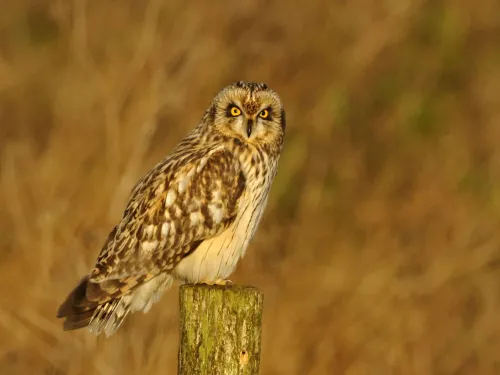
Short-eared owl
The short-eared owl, or 'Shortie', is an unusual owl because it prefers to be out and about in the daytime. Learn more about it in our species information page.

Sprinkled with diminutive, short-living flowers in spring and parched dry by July, this is a habitat of heathlands, coastal grasslands and ancient parkland.
Lowland dry acid grassland is found in pastoral landscapes in the warm, dry southern lowlands on acidic, often sandy, soils. The best examples can be species-rich, with up to 25 plant species per square metre. In addition to fine grasses, lichens and mosses, these include small rosette-forming species such as cat’s-ear and mouse-ear hawkweed, low-growing herbs such as sheep’s sorrel and bird’s-foot-trefoil, and tiny annuals such as common stork’s-bill, changing forget-me-not, and parsley piert. The vegetation varies with climate and a less diverse form is found in moister upland fringes and in south-west England, while in Scotland it can be found on stable river shingle.
Acid grassland develops when heavy grazing on heathland slowly eliminates heather, or following reversion from temporary cultivation on heathland soils (provided these have not been heavily limed or fertilised). If grazing pressure is subsequently reduced, the heather can re-establish, and there has probably always been some ebb and flow between acid grassland and dry heathland.
Lowland acid grassland is generally grazed today, although in some places it is maintained through very regular cutting, for example on air fields and golf courses. However, grazing animals (including rabbits) are ideal for creating a diverse habitat - the disturbance created through trampling and burrowing results in a small-scale mosaic of short vegetation and bare ground. This is suitable for the more ephemeral species that would otherwise soon become crowded out if more vigorous species had the opportunity to become established. Heavy machinery can also damage the fragile soils, so is best avoided, although rotovation (the use of aquatic rotovators, which have underwater blades to uproot aquatic plants as a means of plant control) is successfully used to disturb lowland dry acid grassland in Breckland, where there is a long history of rotational cultivation of the poor soils (‘brecks’ were fields temporarily cultivated then allowed to revert to grassy heath).
Mainly found in the warm and dry lowlands of England, with key locations including Breckland, the Suffolk Sandlings, the New Forest and the Dorset and Wealden heaths.
Sandy soils on particularly open and parched acid grassland can support a range of ground dwelling and burrowing insects. The impressive black and brown field cricket (lost from all but one site before being subsequently reintroduced to others within its former range) remains rare, but look out for mining bees and wasps, particularly on warm, south facing banks, and for butterflies such as grayling, green hairstreak and small heath.
The enigmatic stone curlew is associated with lowland dry acid grassland and is best seen at publicised reserves, for example in Breckland. Woodlarks are also attracted to the short sparse turf where they prey on invertebrates, particularly if there is taller grass or heather nearby for nesting - listen out for their fluid, spiralling song from early spring. Adders like deep cover and can be found on the heathy margins of acid grassland.
Characteristic plants are small in stature, but make up for it in interest – look out for rare and scarce plants such as the tiny red mossy stonecrop, a suite of rare clovers and Breckland specialities including sand catchfly, perennial knawel and spring speedwell. Also in the Brecks, look out for characteristic ‘stone striping’ where deep acid sand and chalk alternate, creating a corresponding pattern in the vegetation.
Much lowland dry acid grassland was lost in the 20th century through afforestation and agricultural improvement, and there have been ongoing declines in the area of grassland and in the fortunes of characteristic species. A decline in plant species-richness has been associated with air pollution, while changes in agriculture have led to a decline in traditional grazing and an increase in the amount of bracken and scrub. Suitable management practices are well-understood, but lowland heathland is generally prioritised over lowland dry acid grassland, even though this is the scarcer habitat in some areas.
The short-eared owl, or 'Shortie', is an unusual owl because it prefers to be out and about in the daytime. Learn more about it in our species information page.
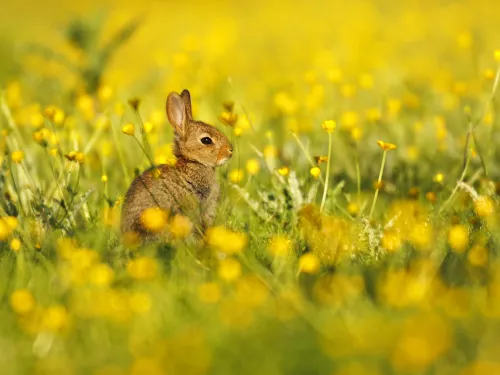
Who doesn’t love spotting rabbits hopping through long grass during a walk in the countryside? They are a common sight but it is always a treat to see their curious faces popping up, ears stood tall on the look out for predators.
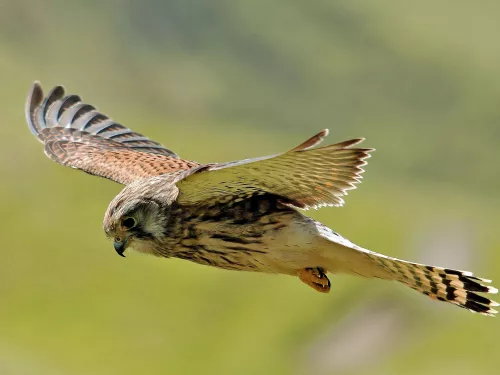
The kestrel is a familiar sight hovering over the side of the road, looking out for its favourite food: small mammals like field voles. It prefers open habitats like grassland, farmland and heathland, but can be seen in towns and villages.
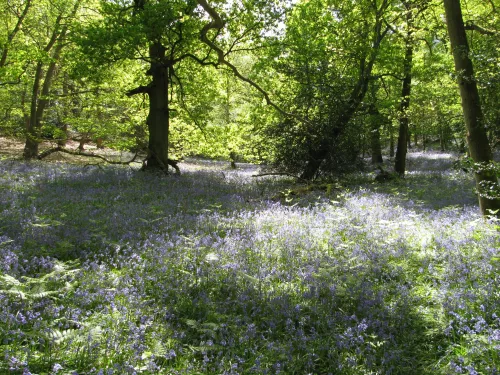
'Relic' wood pasture, veteran trees and nationally rare acid grassland make up this site squeezed between major roads, railway lines, and the rapid urban development of Ashford.
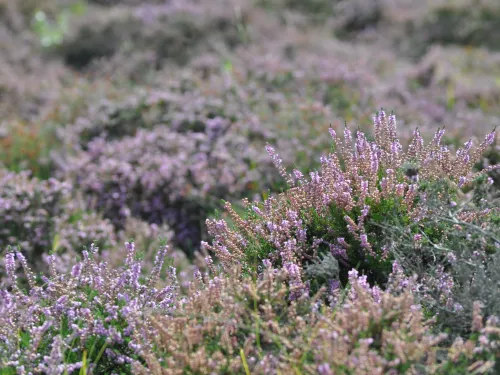
Rich in flora and fauna, this important reserve contains Kent's last four valley bogs and one of its few remaining fragments of open heath.